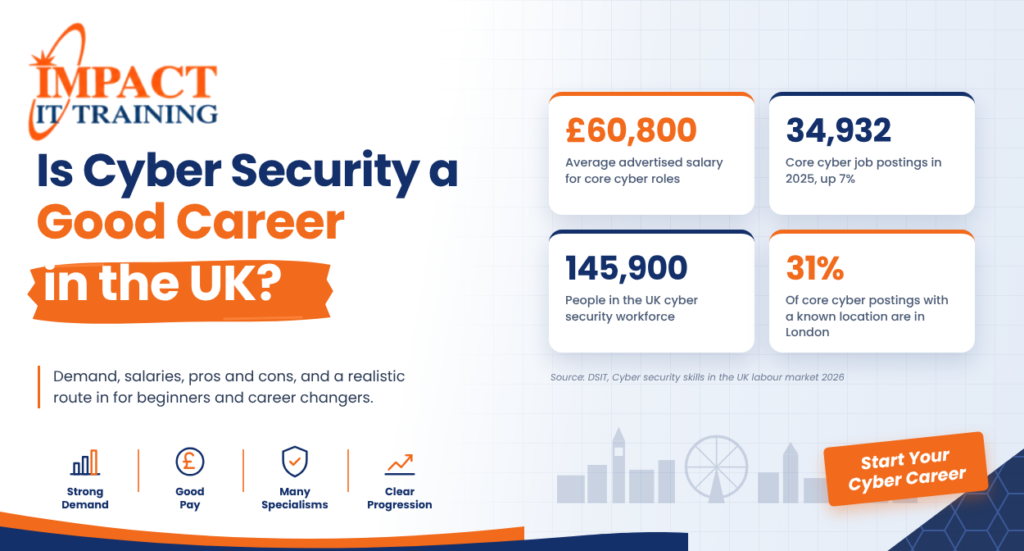
Is cyber security a good career in the UK? Yes, for people with the right foundations, but it is more competitive than it was. Core UK cyber job postings rose 7% in 2025 to 34,932 and advertised pay averaged £60,800, yet entry-level postings have roughly halved since 2022.
With a growing threat landscape and increased compliance requirements, is cyber security a good career in the UK in 2026? Yes. The profession has good job security, a salary of £60,800 on average, and many specializations. But candidates will encounter a tough entry-level job market where employers prefer candidates with proven technical skills and experience.
Is Cyber Security in Demand in the UK in 2026?
Is cyber security in demand in the UK? Yes, but the hiring process is not evenly spread across the country and across all experience levels. Official government numbers show that the job market is becoming stable, and it is mainly looking for experienced workers instead of beginners without qualifications.
To get a better understanding of what cybersecurity is about and how it functions, we should analyze the current metrics and trends.
| Metric (2025 Data) | Figure |
| UK cyber workforce | ~145,900 (+2%, vs +5% prior year) |
| Core cyber job postings | 34,932 (avg 2,911/month), +7% on 2024 |
| All cyber-related postings | 66,964, +10% |
| Core postings vs 2022 | −51% |
| Postings asking for <2 years’ experience vs 2022 | −53% |
| Postings asking for 2–6 years’ experience | 64% of total postings |
| Businesses with a basic technical skills gap | 57% (up from 49%) |
| Firms expecting to grow headcount in 2026 | 53% (down from 67%) |
Key Market Observations
- Regional Distribution: London holds a 31% share of cybersecurity jobs, followed by the South East (13%), North West (9%), and Scotland (9%).
- Remote Work: Fully remote roles stand at 16%, whereas 28% was the highest when remote roles were at their peak.
- In-Demand Specialisms: Governance, Risk, and Compliance (GRC) positions are the most sought after. Employers are mainly looking for Security Managers (27%), Security Analysts (26%), and Security Engineers (21%).
- Core Skills: Important skills include knowing frameworks like ISO 27001 (20%), handling incidents (18%), and understanding Microsoft Azure security systems (16%).
Cyber Security Career UK Salaries: What You’ll Really Earn
When looking at a cyber security career in the UK, salary is one of the biggest reasons people are interested. Most published pay numbers focus on mid-level and senior jobs because 76% of job ads don’t include specific salary amounts.
| Measure | Figure | Source |
| Mean advertised salary, core cyber roles | £60,800 | Official Gov Data 2026 |
| Median advertised salary | £58,050 | Official Gov Data 2026 |
| London / Scotland / N. Ireland mean | £70,200 / £63,100 / £51,600 | Official Gov Data 2026 |
| Graduate median band (~15 months post-grad) | £30,001–£35,000 | Official Gov Data 2026 (HESA) |
| IT security co-ordinator | £35,000–£60,000 | National Careers Profile |
| Premium over wider IT (median) | ~11% (£58,050 vs £52,260) | Official Gov Data 2026 |
For realistic entry points, industry recruitment data from Walbrook estimates initial entry-level salaries around £25,000 for basic IT security support, rising to approximately £35,000 for junior SOC analysts. To see how these figures stack up against wider technology sectors, review our breakdown of the highest paying IT jobs in the UK.
Cyber Security Career Pros and Cons
Knowing the equation of positives and negatives will help you decide whether cyber security is a good career path for you. The list of cyber security career pros and cons will give you an honest idea about the career opportunities:
Pros
- Competitive Pay: Consistently earns above the general IT median salary.
- Diverse Specialisms: 15 unique paths in the UK Cyber Security Council framework (like forensics, auditing, and architecture).
- Flexible Work Models: Lots of hybrid work opportunities and a welcoming atmosphere (22% of our workers think differently).
- Clear Progression: Defined career paths toward leadership, governance, and architecture.
Cons
- Saturated Entry Tier: High candidate competition for entry-level titles.
- Strict Requirements: 77% of job ads in the main occupation require a degree, but fewer jobs require a degree.
- Experience Bias: 64% of hiring openings require experience in the range of 2-6 years.
- Lifelong Learning: Constant demands for training and recertification.
Is Cyber Security Stressful?
Stress in the workplace is something to be considered when analyzing tech jobs. Is cyber security stressful? It really depends on your specific field and position:
- High-Pressure Sectors: Incident response teams work under pressure to address sudden system outages, strict resolution times, and weekend duty.
- Broader Operational Roles: Most employees work in governance, risk and compliance (45%), or audit and assurance (37%). These employees work according to the set business timeline and business hours.
- Industry Turnover: Staff turnover in the UK cyber sector increased to 14% over a year and a half, going up from 12%. This shows that there is high demand for workers in fast-moving security jobs.
“Stress in cyber security often comes from working in situations where you have to react quickly and don’t have the right tools. ” When you move into active jobs like compliance, security design, or auditing, the tasks become organized and easier to handle.
Will AI Replace Cyber Security Jobs?
Many new people worry that robots and computers will take over the jobs of security workers. So, will AI replace cyber security jobs?
The simple answer is “No.” AI is automating routine tasks but not replacing employees.
- Day-to-Day AI Use: 70% of UK security firms say that their workers use AI technology daily, an increase from 53% in previous surveys.
- Shift in Entry Duties: Automation tools have taken over log triaging and basic alert filtering tasks. This is why 9% of job openings specifically require workers with knowledge of AI tools, while 15% need automation skills.
- Growth in AI Defense: Based on the Cybersecurity Sectoral Analysis, AI-specific security jobs have increased by 51%.
Employers still require human involvement to understand the context of the business, investigate, and make decisions about any threats. Today, being successful means understanding basic security ideas while also using modern automation tools. If you are getting ready for these new jobs, check out our guide on cybersecurity specialist training; it’s a helpful place to start.
Is Cyber Security a Good Career for Beginners?
Is cyber security a good career for beginners in the UK? Are companies hiring now? Yes, but it’s hard to find a first job without some tech experience.
Only 16% of security jobs are open to people who have less than a year of specific experience. Employers often want basic IT skills from candidates before they apply for specific security jobs.
Realistic Entry Pathways
- Starting Roles: Most new people begin with IT helpdesk support, junior network administration, or security administration before moving on to specific analyst roles.
- Penetration Testing Context: Many new people want to become ethical hackers right away. However, penetration testers make up about 2% of all job openings. If this is your goal for the future, check out our guide on becoming an ethical hacker.
- Educational Routes: Most job ads (77%) ask for formal qualifications, but some (12%) will accept Level 4 or Level 6 apprenticeships, T Levels, or similar certificates.
- Certification Order: Don’t rush into advanced certifications right away. Instead, create a strong base little by little. Find out which CompTIA certification to start with to create a good starting point.
Is Cyber Security a Good Career Change at 30, 40 or 50?
Considering a mid-career switch involves the following questions: Is cyber security a good career change for mature people?
Changing from other professions like finance, legal compliance, risk analysis, or project management gives you a very useful context to work with. Research conducted by the government on its workforce shows that more than 2,700 people a year move into the UK cyber industry from outside traditional professions, and mature students are an important part of part-time retraining programs. While age itself is not a barrier, career changers must back up their previous professional experience with verified technical training when switching into IT.
A Realistic Roadmap with Impact IT Training
To have success in the market, you need an effective strategy for action. Here are some easy steps to begin your career in cybersecurity:
- Establish Technical Skills: Gain knowledge of key networking protocols, learn how to use operating systems such as Linux and Windows, and fix hardware issues.
- Obtain Recognized Baseline Certifications: Show your competencies through neutral certifications such as CompTIA Network+ or CompTIA Security+.
- Create Hands-on Lab Projects: Gain hands-on experience through home labs, virtual environments, and websites such as TryHackMe and Hack The Box. Keep track of your progress to showcase your hands-on experience to employers.
- Specialize & Apply for Relevant Roles: Tailor your applications for roles that you specialize in and are suitable for beginners, such as SOC Analyst, IT Security Administrator, and Compliance Assistant.
Are you ready to begin your cyber security adventure? Explore Impact IT Training Cyber Security Courses Today
Final Verdict
So, is cyber security a good career in the UK? For individuals ready to build a solid technical base and learn practically, there are good career opportunities, earning potential, and areas for specialization in this field. Although the industry no longer values merely theoretical knowledge, preparation will enable you to distinguish yourself in the job market.
Impact IT Training bridges the UK cyber skills gap with hands-on, certification-focused programs built for real-world job success.
FAQs
- Is cybersecurity still in demand in the UK?
Yes. Core job postings increased by 7%, but employers look for candidates with hands-on technical experience.
- Is cybersecurity a good career for beginners with no experience?
Yes, but highly competitive. Start by building the basics of IT skills, get certifications, and create some hands-on lab projects.
- Do you need a degree to work in cybersecurity in the UK?
No. Level 4/6 apprenticeship, industry certifications, and practical experience can be an alternative way of getting into the industry.
- How much do cybersecurity jobs pay in the UK?
Core jobs pay £60,800 (median £58,050), while graduate positions start from £25,000 – £35,000.
- Is cyber security stressful?
The incident response function has deadlines, whereas the governance, risk, and auditing functions have more regular working hours.
- Is cyber security a good career change at 30, 40, or 50?
Yes. A background in Risk, Compliance, and Management nicely matches technical retraining.
- Will AI replace cybersecurity jobs?
No. AI performs basic log filtering; human judgment is needed for context, strategy, and compliance.